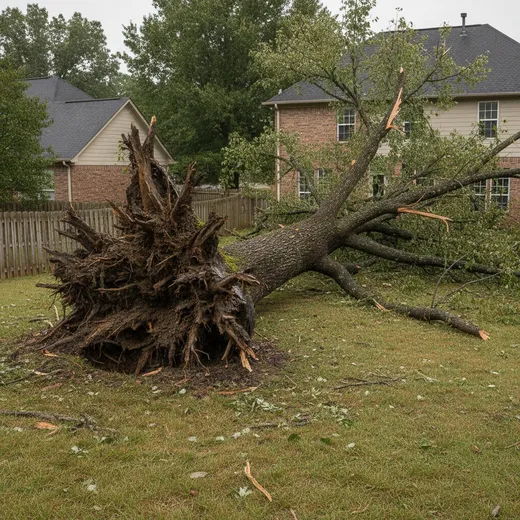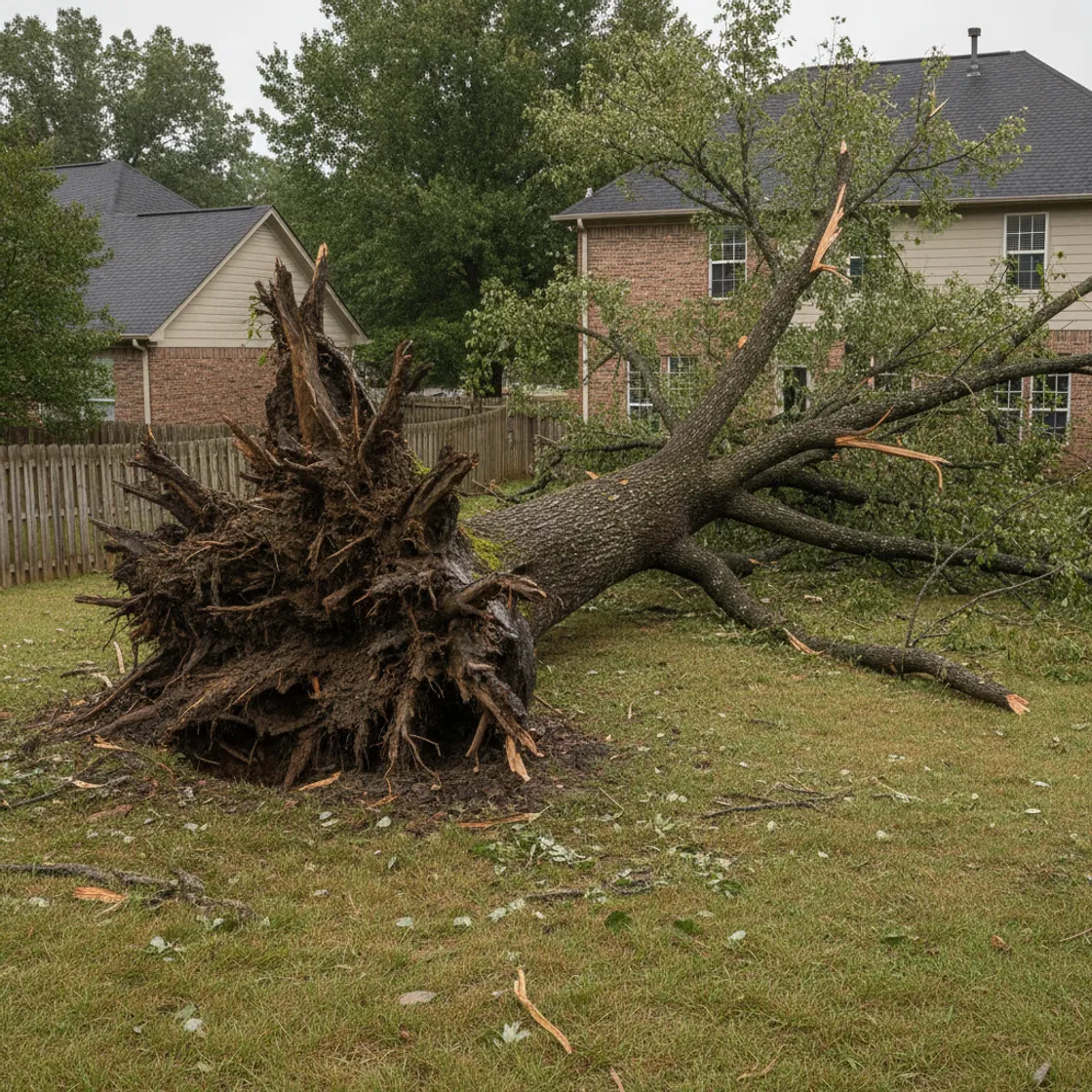
Metro Atlanta gets the kind of storms that bring trees down: summer thunderstorms with straight-line winds, the tail ends of tropical systems in late summer, and ice that overloads limbs in winter. When one comes down on your property, the instinct is to rush out and start dealing with it. The safer move is to slow down for a minute and work through this in order.
First, make sure everyone is safe
Before anything else, account for everyone in the home and check for injuries. If a tree has come through the roof or a wall, get everyone out of that part of the house and stay clear of the damaged area, since a compromised roof or ceiling can keep failing after the initial hit. If anyone is hurt or trapped, or if you smell gas, call 911 first. The tree can wait; people cannot.
Assume every downed line is live
This is the step people get wrong. A fallen tree very often brings a power line down with it, and a line lying in the yard or tangled in the branches can be energized even if the power is out and even if it is not arcing or sparking. Treat every downed line, and anything touching it, as live and deadly.
Around downed lines:
- Stay well back, at least the length of another tree, and keep children and pets inside.
- Never touch the tree, a fence, or any metal that a line might be touching. The charge can travel through all of it.
- Do not try to move the branch or the wire yourself, no matter how small it looks.
- Call your utility to report the line, and let them de-energize it before anyone works on the tree.
Document it for insurance
Once you are safe and away from any lines, take photos and video of everything before it is moved: the tree, the damage to the house or fence or car, and the wider scene. Do this from a safe distance. Good documentation makes an insurance claim far smoother, and most policies want to see the damage as it landed. It is also fine to make temporary steps to prevent further damage, like a tarp over an opening, once it is safe to do so; keep the receipts.
Then call your insurance company to start the claim and ask what they need. We cover how coverage usually works in more detail in our post on insurance and tree removal.
Call a professional before you cut
A downed tree is a tangle of stored energy. Limbs pinned under tension can whip when cut, a trunk resting on a roof can shift the moment weight comes off it, and a partly uprooted tree can drop the rest of the way without warning. This is not a chainsaw-and-a-ladder job. A crew that does this every day reads where the tension is, rigs the heavy pieces, and takes the load off a structure in the right order. When the tree is on the house, a crane lets us pick sections straight up and away instead of dragging them across the roof.
How Engram's Tree Service can help
We have handled storm damage around metro Atlanta for more than 25 years, and Larry runs a crane with an extra-long boom for exactly the trees that end up on rooftops and across driveways. If a tree is down on your property, get everyone safe, stay clear of any lines, and then call or text our 24-hour line. We will tell you what we see and what it takes to make it safe.